Ready to Track Insider Trading?
Join thousands of investors using InsiderTradeFlow to follow executive trades in real-time.
Join thousands of investors using InsiderTradeFlow to follow executive trades in real-time.
Among all insider trading signals, cluster buying stands out as the most reliable predictor of future stock performance. When multiple corporate executives simultaneously reach into their own pockets to buy company stock, they're sending a powerful collective message about their confidence in the company's future.
This guide explains what cluster buying is, why it works, how to identify meaningful clusters, and how to incorporate this strategy into your investment process.
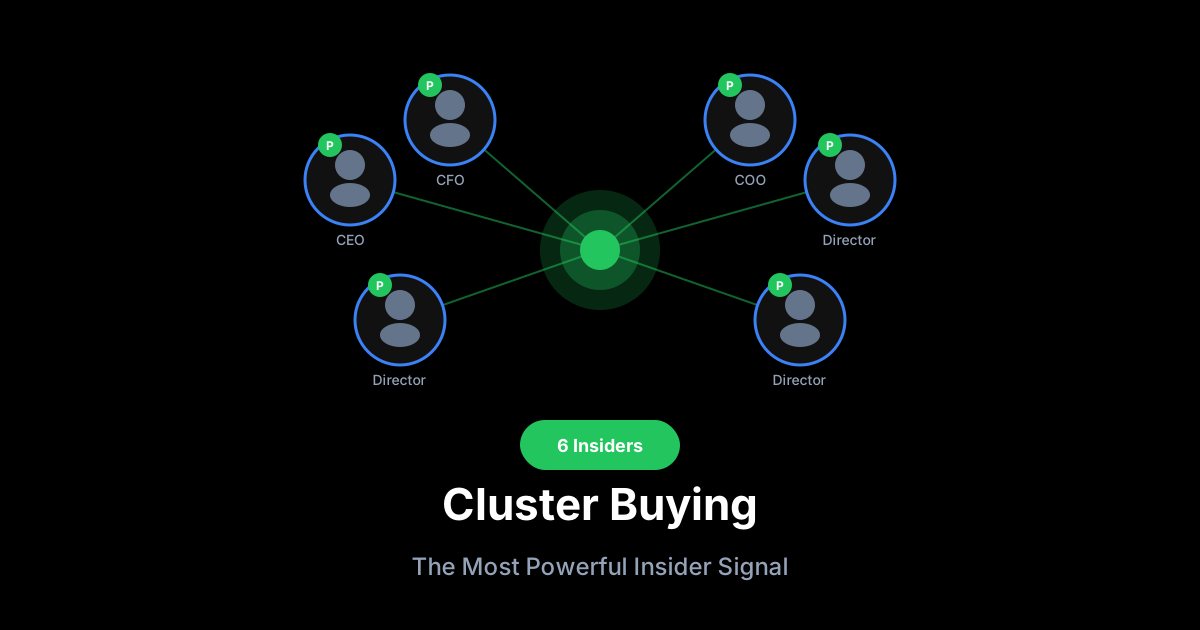
Cluster buying occurs when multiple insiders at the same company purchase stock within a concentrated time period - typically 30 to 90 days. Unlike a single insider purchase, which might reflect one person's view or circumstances, cluster buying represents a consensus among leadership.
Consider the difference:
Single Buyer: The CEO purchases $500K in stock
Cluster Buying: CEO, CFO, and two directors each purchase $200K+ within 60 days
Statistical Edge: Research consistently shows cluster buying outperforms single-buyer signals by 2-3x on a risk-adjusted basis.
Reduced Coincidence: One insider buying could be coincidental timing. Three or more buying simultaneously suggests shared positive expectations.
Information Aggregation: Different executives have different information. The CEO knows strategy, the CFO knows finances, directors know governance. Agreement across roles is meaningful.
Academic and practitioner research has studied insider trading patterns for decades. The findings on cluster buying are remarkably consistent.
Seyhun (1986-2000s): Foundational research showing insider purchases predict positive returns, with multi-buyer transactions showing stronger effects.
Lakonishok & Lee (2001): Found aggregate insider buying at the firm level is more predictive than individual transactions.
Jeng, Metrick & Zeckhauser (2003): Demonstrated that insider purchases earn significant abnormal returns, particularly when clustered.
| Signal Type | 12-Month Alpha | Win Rate |
|---|---|---|
| Single insider buy | +3-5% | 55% |
| Two insiders buy | +5-8% | 60% |
| Three+ insiders buy | +8-15% | 65% |
| CEO + CFO cluster | +10-18% | 68% |
Based on aggregated research data; past performance does not guarantee future results
Information Asymmetry: Insiders know things the market doesn't - product pipelines, competitive dynamics, financial projections.
Behavioral Finance: Most investors ignore Form 4 filings entirely, creating an exploitable inefficiency.
Signal Quality: Cluster buying filters out noise that plagues single-transaction analysis.
Not all cluster buying is created equal. Here's how to separate strong signals from weak ones.
1. Number of Participants
| Participants | Signal Strength |
|---|---|
| 2 insiders | Moderate |
| 3 insiders | Strong |
| 4+ insiders | Very Strong |
More participants = more conviction = stronger signal.
2. Role Diversity
The strongest clusters include diverse roles:
Optimal Mix:
Weaker Mix:
3. Time Concentration
| Timeframe | Interpretation |
|---|---|
| Within 7 days | Very tight cluster - possibly coordinated |
| 7-30 days | Strong natural cluster |
| 30-90 days | Meaningful cluster |
| 90+ days | Weaker connection |
4. Dollar Significance
For each participant:
5. Position Impact
Calculate how much each insider's position increased:
Same-Day Buying: When all insiders buy on exactly the same day, it may be coordinated for PR purposes rather than independent conviction.
Family Clusters: Purchases by CEO + CEO's spouse + CEO's trust may represent one decision, not multiple perspectives.
Small Amounts: Clusters of $10K purchases don't demonstrate meaningful conviction.
Post-Decline Buying: If a cluster follows a 50%+ stock decline, verify the company isn't in distress.
Track all Form 4 filings with transaction code "P" (purchase):
For each company in your universe, maintain a rolling count:
Cluster Score = Number of unique insiders buying in past 90 days

If Cluster Score >= 3:
  FLAG as Potential Signal

If Cluster Score >= 3 AND includes C-suite:
  FLAG as Strong Signal
For each flagged cluster, verify:
Before acting on a cluster signal:
For validated clusters:
Criteria:
Position Sizing: Equal weight across all qualifying positions
Holding Period: 12 months
Exit Rules:
Criteria:
Rationale: Insiders buying undervalued stocks suggests they see value the market is missing.
Criteria:
Rationale: Insiders buying stocks with positive momentum suggests they expect continued strength.
Criteria:
Rationale: Information asymmetry is greatest in small caps, making insider signals more predictive.
Situation: Enterprise software company trading at 5-year lows after missed guidance.
Cluster Signal:
Context: Company announced restructuring plan, new product roadmap, and raised guidance 6 months later.
Outcome: Stock rose 120% over following 12 months.
Lesson: Cluster buying during extreme pessimism can signal turnaround potential.
Situation: Healthcare company with steady fundamentals, no obvious catalysts.
Cluster Signal:
Context: Company was acquired at 40% premium 8 months later.
Outcome: Investors who followed the cluster captured most of the acquisition premium.
Lesson: Sometimes clusters precede events that insiders may anticipate (through proper legal channels).
Situation: Retail company facing secular decline in foot traffic.
Cluster Signal:
Context: Company's problems were structural (e-commerce competition), not temporary.
Outcome: Stock declined another 40% over next 12 months before eventual bankruptcy.
Lesson: Cluster buying doesn't guarantee success. Fundamentals and industry dynamics still matter.
Problem: Treating all clusters equally regardless of circumstances.
Solution: Always investigate why the cluster might be occurring. Is it:
Problem: Counting grants, exercises, or 10b5-1 sales in cluster analysis.
Solution: Strict filtering for Code P (purchase) transactions without 10b5-1 plans.
Problem: Cluster occurred 6 months ago but you're just seeing it.
Solution: Focus on clusters within the past 90 days. Older clusters have diminished signal value.
Problem: Building portfolio of 20 cluster-buy stocks in same sector.
Solution: Diversify across sectors and maintain position limits.
Problem: Selling after 30 days because "nothing happened."
Solution: Cluster signals typically play out over 6-12 months. Patience is essential.
Create a weighted scoring system:
Base Score: 0

Add points for:
+10: 3 or more participants
+5: CEO participating
+5: CFO participating
+3: Each additional C-suite
+5: Average purchase >$200K
+5: Average position increase >15%
+3: Buying during stock decline
+5: Small cap (<$2B market cap)

Subtract points for:
-5: Same-day clustering (possible coordination)
-3: Family members only
-5: Any 10b5-1 transactions included
-3: Very small purchases (<$25K average)

Strong Signal: Score > 25
Moderate Signal: Score 15-25
Weak Signal: Score < 15
Track aggregate cluster activity by sector:
This approach captures where insider conviction is flowing across the market.
High short interest + cluster buying = potential short squeeze setup
Criteria:
Within 2-4 weeks of the cluster completing. Form 4 filings have a 2-day lag, and you need time to verify the cluster and research the company. Acting within a month captures most of the signal value.
Three is the threshold for statistical significance. Two insiders buying is worth noting, but three or more dramatically increases predictive value. Academic research consistently supports this threshold.
Yes, moderately. CEO purchases carry extra weight because of comprehensive company visibility. However, the power of clusters comes from multiple perspectives, so don't over-weight any single participant.
Tighter timeframes are better. A cluster where all purchases occur within 30-60 days is stronger than one spread over 6 months. Long-duration clusters may reflect separate decisions rather than coordinated conviction.
Net activity matters. If three insiders are buying but one is selling heavily, investigate the selling. If the net is still clearly bullish (more buyers, larger buy dollars), the signal remains valid. If selling dominates, it's not a true bullish cluster.
Yes, but with caveats. Cluster buying during bear markets can identify relative winners, but macro factors may limit absolute returns. During bear markets, focus on clusters in defensive sectors and strong balance sheets.
InsiderTradeFlow automatically detects cluster buying patterns across 10,000+ stocks. Our Cluster Alert system notifies you when 3+ insiders purchase within 90 days, with our proprietary scoring to rank cluster quality. Start your free trial today.