Ready to Track Insider Trading?
Join thousands of investors using InsiderTradeFlow to follow executive trades in real-time.
Join thousands of investors using InsiderTradeFlow to follow executive trades in real-time.
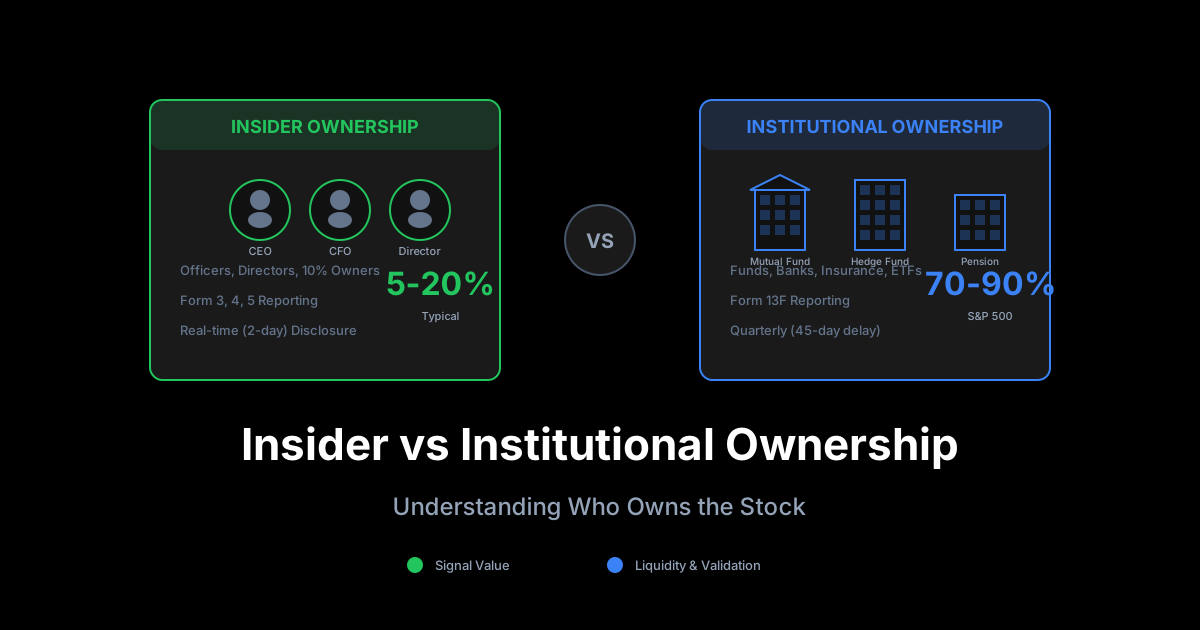
When analyzing a stock, two ownership metrics frequently appear: insider ownership and institutional ownership. While both measure who holds shares, they represent fundamentally different investor types with different motivations, time horizons, and information access.
Understanding the distinction between insider and institutional ownership - and what each reveals about a company - is essential for thorough investment research.
Insider ownership represents shares held by people with direct access to company information and decision-making authority.
The SEC defines insiders as:
Officers: CEO, CFO, COO, and other executive officers Directors: Board members, both inside and independent 10% Owners: Any individual or entity owning 10%+ of voting shares
These individuals must report their holdings and transactions through SEC Forms 3, 4, and 5.
Insider Ownership % = (Shares held by insiders / Total shares outstanding) × 100
What's included:
What varies by data source:
This is why you may see different insider ownership percentages from different sources for the same company.
| Company Stage | Typical Range | Notes |
|---|---|---|
| Pre-IPO/Early-stage | 30-70% | Founders retain large stakes |
| Recent IPO | 15-40% | Dilution from offerings |
| Growth company | 5-20% | Continued dilution, insider selling |
| Mature large-cap | 1-5% | Primarily compensation-based |
| Family-controlled | 20-50%+ | Multi-generational holdings |
Institutional ownership represents shares held by professional investment entities managing money on behalf of others.
Mutual Funds: Vanguard, Fidelity, T. Rowe Price Hedge Funds: Citadel, Renaissance, Two Sigma Pension Funds: CalPERS, Ontario Teachers Insurance Companies: MetLife, Prudential ETF Providers: BlackRock (iShares), State Street (SPDRs) Endowments: Harvard, Yale, Stanford
Any investment manager with over $100 million in equity assets must file quarterly 13F reports disclosing their holdings.
Institutional Ownership % = (Shares held by 13F filers / Total shares outstanding) × 100
Important caveats:
| Company Type | Typical Range | Notes |
|---|---|---|
| S&P 500 companies | 70-90% | Heavy index fund ownership |
| Mid-caps | 60-80% | Active manager interest |
| Small-caps | 30-60% | Less analyst coverage |
| Micro-caps | 10-40% | Limited institutional access |
| Insider-controlled | 40-60% | Float constraints |
| Factor | Insider Ownership | Institutional Ownership |
|---|---|---|
| Who | Officers, directors, 10% owners | Professional money managers |
| Information Access | Non-public, material information | Public information only |
| Time Horizon | Typically long-term (years) | Varies (days to years) |
| Motivation | Company success, wealth building | Client returns, benchmarks |
| Trading Restrictions | Blackout periods, pre-clearance | Generally unrestricted |
| Reporting | Real-time (2-day Form 4) | Quarterly (45-day lag 13F) |
| Signal Value | High (buying especially) | Moderate (sentiment indicator) |
Insiders have superior information. They know:
When insiders buy with their own money, they're expressing confidence based on information unavailable to other investors.
Institutions have research resources. They employ:
But they're legally prohibited from trading on material non-public information.
Insiders face restrictions:
Institutions trade more freely:
High insider ownership means executives benefit when the stock rises and suffer when it falls. This alignment can:
Research findings: Studies show moderate insider ownership (5-25%) correlates with better long-term performance.
Changes in insider ownership provide signals:
Increasing ownership (buying):
Decreasing ownership (selling):
Single sales are noisy; patterns of selling across multiple insiders deserve attention.
Very high insider ownership (>50%) creates risks:
Very low insider ownership (<1%) raises questions:
The ideal is moderate insider ownership - enough for alignment, not so much for entrenchment.
High institutional ownership indicates:
Institutional activity provides:
Low institutional ownership often means:
Large institutions increasingly engage on:
Companies with high institutional ownership face more scrutiny and pressure for good governance.
High institutional ownership:
Low institutional ownership:
SEC EDGAR: Search for Forms 3, 4, 5 and proxy statements (DEF 14A)
Proxy Statements (DEF 14A): Annual filings include ownership tables showing all insider holdings
Key sections in proxy:
SEC EDGAR: Search for 13F-HR filings by institutional managers
Company proxy statements: Often summarize major institutional holders
Financial platforms: Yahoo Finance, Google Finance show aggregated data
13F timing note: Filings are due 45 days after quarter end, so data can be 3+ months stale by the time you see it.
Services like Bloomberg, FactSet, S&P Capital IQ, and others aggregate both insider and institutional ownership data with various analytical tools.
Ideal characteristics:
Insider red flags:
Institutional red flags:
Technology:
Financials:
Utilities:
Biotech:
Levels tell you the current state.
Changes tell you the trend.
For investment signals, changes often matter more than absolute levels.
Insider data is timely: When a CEO buys stock, you know within 2 days.
Institutional data is stale: When a hedge fund builds a position, you might not know for 4+ months.
This timing difference makes insider activity more actionable for short-term signals.
Yes, if they own 10%+ of the company. A hedge fund accumulating a large position becomes a "beneficial owner" subject to insider reporting rules (Schedules 13D/13G) and potentially Form 4 requirements.
Several reasons: Market cap too small for institutions, lack of analyst coverage, limited trading liquidity, sector out of favor, governance concerns, or controlled by insiders/family.
Not always. Very high insider ownership (>50%) can entrench management, weaken minority shareholder rights, and create governance issues. Moderate levels (5-25%) typically optimal.
It depends. Some calculations include vested, exercisable options. Others only count actual shares owned. This creates discrepancies between sources. Always check methodology.
Both matter, but differently. Insider ownership shows alignment and can signal via transactions. Institutional ownership shows validation and liquidity. For investment signals, insider buying tends to be more predictive.
For insiders: Monitor Form 4 filings regularly (daily or weekly). For institutions: Quarterly reviews after 13F deadlines are sufficient given the data lag.
About their own company, generally yes. But insiders may not understand macro factors, relative valuation, or competitive dynamics as well as sophisticated institutional analysts. Both perspectives have value.
InsiderTradeFlow combines insider transaction tracking with ownership analytics, showing you not just who owns shares, but who's buying and selling - and whether those trades signal conviction. Our Executive Conviction Score goes beyond raw ownership to measure actual insider confidence. Try it free for 14 days.