Ready to Track Insider Trading?
Join thousands of investors using InsiderTradeFlow to follow executive trades in real-time.
Join thousands of investors using InsiderTradeFlow to follow executive trades in real-time.
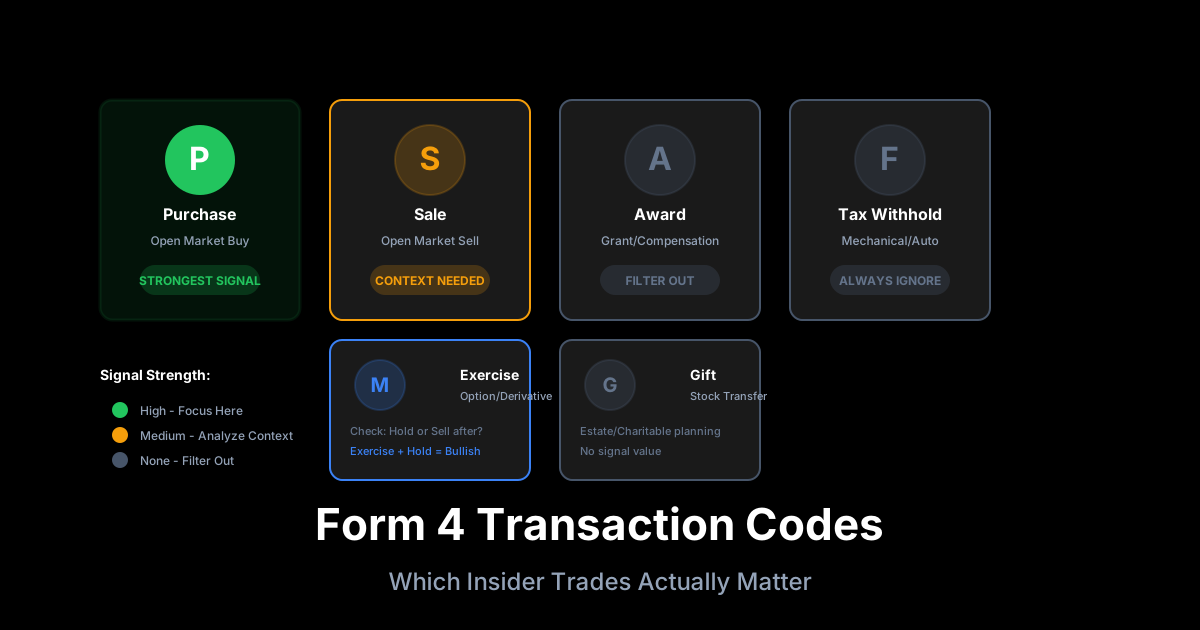
Every Form 4 filing includes a transaction code - a single letter that tells you what type of trade occurred. This seemingly minor detail is actually the most important factor in determining whether an insider transaction is a genuine investment signal or meaningless noise.
Understanding transaction codes transforms raw Form 4 data into actionable intelligence. Here's how to interpret each code and focus on the trades that matter.
Consider two identical-looking transactions:
Transaction A: CEO acquires 10,000 shares at $50/share ($500,000 total) Transaction B: CEO acquires 10,000 shares at $50/share ($500,000 total)
Without knowing the transaction code, these look the same. But:
The transaction code is the difference between signal and noise.
| Code | Transaction Type | Signal Value |
|---|---|---|
| P | Open market or private purchase | HIGH |
| S | Open market or private sale | Medium |
| A | Grant, award, or acquisition from issuer | Low/None |
| D | Sale to issuer (stock returned to company) | Low |
| F | Payment of exercise price or tax via share withholding | None |
| I | Discretionary transaction (as directed) | Context-dependent |
| G | Gift | None |
| L | Small acquisition (SEC Rule 16a-6) | Low |
| M | Exercise or conversion of derivative | Medium |
| C | Conversion of derivative | Medium |
| E | Expiration of short derivative | None |
| H | Expiration of long derivative | None |
| O | Exercise of out-of-the-money derivative | Rare |
| X | Exercise of in-the-money derivative | Medium |
| U | Disposition due to tender of shares | Context-dependent |
| W | Acquisition or disposition by will/laws of descent | None |
| Z | Deposit into or withdrawal from voting trust | None |
| J | Other acquisition or disposition | Context-dependent |
| K | Equity swap or similar | Context-dependent |
Table II covers options, warrants, and other derivative securities. The same codes apply but relate to derivative positions rather than underlying shares.
This is the most important transaction code.
When an insider files with Code P, they have:
Why Code P matters:
Code P interpretation:
Open market sales are harder to interpret than purchases.
Why sales are ambiguous:
Insiders sell for many reasons:
And sometimes:
Interpreting Code S transactions:
| Factor | Bearish Signal | Neutral Signal |
|---|---|---|
| Portion of holdings | >25% sold | <10% sold |
| Pattern | Sudden change | Consistent regular sales |
| Timing | Before bad news | After stock run-up |
| Multiple insiders | All executives selling | One person selling |
| 10b5-1 plan | Not under plan | Under disclosed plan |
Best practice: Treat most single Code S transactions as neutral. Pay attention when:
Code A represents shares given as compensation:
Why Code A doesn't signal conviction:
The insider didn't choose to buy. The company gave them shares as payment. This tells you nothing about their view of the stock.
Example: A CEO receives 50,000 shares as an annual bonus. The Form 4 shows Code A. This is compensation structure, not an investment decision.
Filter instruction: Exclude Code A from investment analysis.
Code F appears when shares are withheld to cover tax obligations:
Why Code F is always meaningless:
This is mechanical. When restricted stock vests, the insider owes taxes on the value. The company automatically withholds shares to cover the tax bill. The insider made no decision.
Example: 10,000 RSUs vest (Code A), and 4,000 shares are withheld for taxes (Code F). The insider ends up with 6,000 shares. The Code F sale is purely administrative.
Filter instruction: Always exclude Code F transactions.
Code D represents shares returned to the company:
Signal value: Generally none. These are administrative, not investment decisions.
Stock gifts typically involve:
Signal value: None. Gifts reflect personal financial planning, not investment views.
Note: Large gifts might reduce an insider's economic interest in the company, but the gift itself isn't a sell signal.
Option exercises are mixed signals that require context.
The exercise itself tells you little. Insiders exercise options for various reasons:
The key question: What happens after exercise?
| Post-Exercise Action | Signal |
|---|---|
| Exercise + hold all shares | Mildly bullish |
| Exercise + sell some shares | Neutral |
| Exercise + immediately sell all | Neutral to bearish |
How to identify the pattern:
Look for same-day transactions:
If shares are exercised and immediately sold, the insider is simply monetizing compensation. If shares are exercised and held, they're converting paper options to real stock ownership.
Similar to Code M, but typically involves:
Signal value: Context-dependent. The conversion itself is often mechanical; post-conversion actions matter more.
Code J is a catch-all for transactions that don't fit standard categories:
Interpretation: Always read footnotes. Code J transactions vary enormously in significance.
Red flag: Large Code J sales without clear explanation may warrant investigation.
Equity swaps allow insiders to hedge their exposure without technically "selling":
Signal value: Often bearish. Insiders using swaps may be reducing economic exposure while maintaining technical ownership.
Important: Equity swaps can be used to hedge concentrated positions without triggering sale reporting. Watch for these in footnotes.
Code I indicates transactions executed at the discretion of another party:
Signal value: Low. The insider may not have made the actual decision.
For investment signal analysis, use this basic filter:
Include:
Exclude:
Analyze with context:
Transaction Signal Score:

Code P (purchase):
  Base: +10 points
  Large amount (>$500K): +5 points
  CEO/CFO: +3 points
  During stock decline: +3 points
  No 10b5-1 plan: +2 points

Code S (sale):
  Base: -2 points
  Large portion (>25%): -5 points
  Cluster selling: -5 points
  Under 10b5-1: +3 points (reduces negative)

Code M (exercise):
  Exercise + hold: +3 points
  Exercise + partial sell: 0 points
  Exercise + immediate sell: -1 point

Other codes: 0 points (filter out)
When screening insider transactions:
Form 4 Filing:
Reporting Person: John Smith, CEO
Transaction Code: P (Purchase)
Shares: 25,000
Price: $42.15
Total Value: $1,053,750
10b5-1: No
Footnotes: None relevant
Analysis: CEO purchased over $1M in stock using personal funds, not under a pre-arranged plan. This is a high-conviction signal.
Form 4 Filing:
Reporting Person: Jane Doe, CFO
Transaction Code: A (Award)
Shares: 50,000
Price: $0
Total Value: $0 (grant price)
Footnotes: Annual equity incentive award
Analysis: CFO received shares as compensation. No investment decision made. Filter this out.
Form 4 Filing:
Reporting Person: Bob Wilson, COO
Transaction 1 Code: A (Award - RSU vesting)
Shares Acquired: 10,000
Transaction 2 Code: F (Tax withholding)
Shares Sold: 3,800
Analysis: RSUs vested (Code A) and shares withheld for taxes (Code F). Both transactions are administrative. No signal value.
Form 4 Filing:
Reporting Person: Sarah Chen, VP
Transaction 1 Code: M (Option exercise)
Shares Acquired: 20,000
Exercise Price: $25
Transaction 2 Code: S (Sale)
Shares Sold: 20,000
Sale Price: $48
Analysis: Options exercised and immediately sold. This is compensation monetization, not a bullish signal. The insider captured the option spread ($23/share) but didn't hold the shares.
Form 4 Filing:
Reporting Person: Mike Torres, Director
Transaction Code: M (Option exercise)
Shares Acquired: 15,000
Exercise Price: $30
No corresponding sale transaction
Analysis: Director exercised options and kept all shares. This converts derivative exposure to direct ownership - mildly bullish. Check if this increased their total holdings significantly.
Form 4 footnotes indicate if a transaction was made pursuant to a 10b5-1 trading plan.
For purchases: 10b5-1 purchases are rare but indicate pre-planned confidence.
For sales: 10b5-1 sales are common and reduce signal value. The decision to sell was made months earlier under different circumstances.
Look for footnote language:
Some Form 4s show complex derivative positions:
Focus on net share position changes. If the insider's economic exposure increased (more shares), that's potentially bullish. If it decreased, potentially bearish.
A single Form 4 may contain multiple transactions. Analyze each separately:
Don't aggregate different transaction types.
Alignment and retention. Stock compensation aligns employee interests with shareholders and encourages retention (shares typically vest over time). It also preserves company cash. But for investors analyzing insider activity, Code A transactions are noise.
Net exposure matters. If an insider sells shares but simultaneously buys call options, they may be maintaining or even increasing their effective exposure. Check Table II of the Form 4 for derivative transactions.
Yes. Transaction codes are standardized by the SEC. All Form 4s use the same codes regardless of company, industry, or filing context.
Filter by Code P. Most financial platforms and SEC EDGAR allow filtering by transaction code. Select only Code P to see genuine open market purchases.
Usually yes, but check context. Private purchases between parties (not on a stock exchange) still use Code P. These can be meaningful but may involve related parties or special circumstances. Read footnotes.
Typically Code P or A. If an insider buys shares in the IPO with personal funds, it's Code P. If they receive IPO allocation as compensation, it's Code A. Check the filing context.
Analyze separately. If a Form 4 shows Code A (grant) and Code P (purchase), treat the grant as noise and the purchase as signal. Don't combine them.
Transaction codes are the key to filtering signal from noise in insider trading data. InsiderTradeFlow automatically categorizes transactions by code, filters out compensation-related activity, and surfaces the Code P purchases that indicate genuine conviction. Our Executive Conviction Score weights transaction types, amounts, and patterns to give you a single metric for insider sentiment. Try it free for 14 days.