Ready to Track Insider Trading?
Join thousands of investors using InsiderTradeFlow to follow executive trades in real-time.
Join thousands of investors using InsiderTradeFlow to follow executive trades in real-time.
When Carl Icahn accumulates a 9.9% stake in a company, investors pay attention. When Warren Buffett files a 13G showing Berkshire Hathaway owns 7% of a bank, the stock often moves. These beneficial ownership disclosures reveal when major investors are betting big on a company.
Understanding beneficial ownership - who must disclose, when, and what it means - is essential for interpreting these important market signals.
A beneficial owner is any person or entity with voting power or investment power over securities, regardless of whose name appears on the stock certificate.
Under SEC rules, you are the beneficial owner of securities if you have:
Voting Power: The power to vote or direct the voting of the shares Investment Power: The power to dispose of or direct the disposition of the shares
This broad definition captures many situations where shares aren't directly owned but someone controls them.
Direct ownership: You buy 1,000 shares of Apple in your brokerage account. You are the beneficial owner.
Through a trust: You create a family trust that holds 10,000 shares. If you control the trust's investment decisions, you are the beneficial owner.
Through an LLC: Your LLC holds shares. As the controlling member, you are the beneficial owner.
Spousal holdings: Your spouse owns shares in a joint account. You may be deemed a beneficial owner.
Investment fund: You manage a hedge fund that owns shares. You (and/or the fund) are beneficial owners.
The SEC uses beneficial ownership to prevent people from hiding their true economic interest behind corporate structures, trusts, and other entities.
Without beneficial ownership rules: An activist could accumulate 30% of a company through 10 different LLCs, never disclosing the true position.
With beneficial ownership rules: All shares controlled by the same person or group must be aggregated and disclosed.
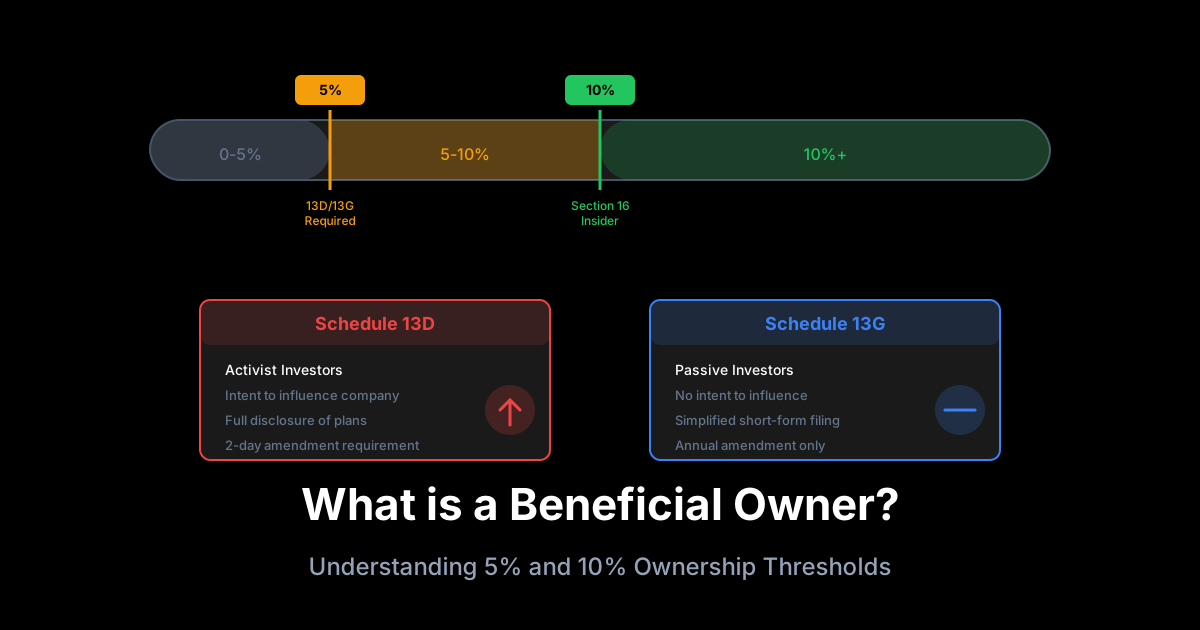
When a person or group becomes the beneficial owner of more than 5% of a public company's voting shares, they must file a disclosure with the SEC.
5.01% or more triggers the filing requirement. Not 5% exactly - you must exceed 5%.
Voting securities only - typically common stock. Preferred stock, bonds, and non-voting shares generally don't count.
10-day deadline - the initial filing is due within 10 calendar days of crossing 5%.
Schedule 13D: The full disclosure, required for investors with activist intentions or who don't qualify for the short form.
Schedule 13G: The short form, available for passive investors who meet specific criteria.
The choice between 13D and 13G depends on the investor's intentions and type.
Schedule 13D is the comprehensive beneficial ownership disclosure, typically filed by investors who may seek to influence the company.
Any beneficial owner exceeding 5% who:
Common 13D filers:
| Item | Description |
|---|---|
| Item 1 | Security and issuer identification |
| Item 2 | Identity and background of filer |
| Item 3 | Source and amount of funds used |
| Item 4 | Purpose of the transaction (most important) |
| Item 5 | Interest in securities of the issuer |
| Item 6 | Contracts relating to securities |
| Item 7 | Materials filed as exhibits |
Item 4 is key. This is where activists disclose their intentions:
13D filers must amend their filing promptly when:
"Promptly" is generally interpreted as within 2 business days of the triggering event.
A new 13D filing signals that:
Stocks often rise 3-10% on significant 13D disclosures, especially from well-known activists.
Schedule 13G is the short-form alternative for investors with no activist intentions.
Three categories of investors can file 13G instead of 13D:
1. Qualified Institutional Investors (QIIs)
Requirements: Must have acquired shares in the ordinary course of business, not to change or influence control.
2. Passive Investors
3. Exempt Investors
| Filer Type | Initial Filing | Amendment Deadline |
|---|---|---|
| QII | 45 days after year-end | 45 days after year-end |
| Passive Investor | 10 days after exceeding 5% | 45 days after year-end |
| Triggering Event | Promptly (10 days) | Promptly if becoming activist |
QIIs get the most flexibility - they only need to file and amend annually unless they exceed 10%.
If a 13G filer:
They must file a 13D within 10 days of the triggering event.
This conversion is often a significant market signal - a passive holder becoming an activist.
Crossing 10% ownership triggers additional, more stringent requirements.
At 10%, a beneficial owner becomes a "reporting person" under Section 16 of the Securities Exchange Act.
New requirements:
Section 16(b) requires 10% owners to disgorge any profits from matching purchases and sales within a 6-month period.
Example: A 10% owner buys shares in January and sells at a higher price in March. The company can recover the profit.
This creates a practical 6-month holding period for 10% owners, limiting their trading flexibility.
Form 4 filings from 10% owners can be as significant as executive insider transactions:
When multiple people or entities act together, their holdings are aggregated for ownership calculations.
A "group" forms when two or more persons agree to:
Aggregation: All group members' shares count together toward the 5% threshold.
Joint filing: Groups can file a single Schedule 13D signed by all members.
Joint liability: Each group member may be responsible for the group's disclosures.
Activist campaigns: Hedge fund + individual investor agreeing to seek board seats.
Family holdings: Spouses, children, and trusts under common control.
Wolf packs: Multiple investors informally coordinating (legal gray area).
Tender offers: Acquirer + financing partners.
Filer identity: Who is accumulating? Track record? Activist history?
Ownership percentage: How significant is the stake? Growing or stable?
Purpose (Item 4): What are their intentions? Passive or activist?
Source of funds: Using leverage? Committed capital?
Recent transactions: Building, trimming, or stable?
New activist 13D: Research the activist's track record. What have they achieved at prior targets?
13G to 13D conversion: Passive holder turning activist often precedes campaign announcement.
Large stake from respected investor: Buffett, Ackman, Icahn holdings often move stocks on disclosure.
Rapid accumulation: Multiple amendments showing quick position building suggests time-sensitive thesis.
When activists file 13Ds, they're often preparing for:
The 13D filing is the opening move, required before the activist can proceed.
Acquirers sometimes build stakes below 10% before announcing tender offers or merger proposals.
Why below 10%: Avoids Form 4 reporting and short-swing rules, maintaining flexibility.
Many companies have "poison pill" provisions triggered at specific ownership levels (often 10-15%).
Hostile acquirers must navigate these thresholds carefully, and their beneficial ownership filings reveal their accumulation progress.
SEC EDGAR: Search for form type "SC 13D" or "SC 13G" by company or filer name.
Direct company search: Company EDGAR pages show all filed ownership schedules.
Filer search: Track specific investors across all their holdings.
| Filing Type | Disclosure Delay |
|---|---|
| 13D initial | Up to 10 days |
| 13D amendment | Up to 2 days |
| 13G (QII) | Up to 45 days + year-end |
| 13G (passive) | Up to 10 days initial |
| Form 4 (10% owner) | 2 business days |
The delay varies significantly. Activist 13Ds are relatively timely. Institutional 13Gs can be months stale.
Track beneficial ownership filings for:
Shareholder of record is the name on the company's books - often a brokerage or custodian. Beneficial owner is who actually controls the shares. You can be beneficial owner without being shareholder of record.
Yes. A fund manager, the fund itself, and the fund's general partner might all be deemed beneficial owners of the fund's shares. Filings often cover all related entities.
No. Schedule 13D/13G only covers beneficial ownership of equity securities, not short positions. This is a significant gap in disclosure.
Often immediately upon filing. Markets monitor EDGAR for new 13Ds from known activists. Stocks can move 3-10% or more on significant disclosures.
SEC enforcement. Penalties can include fines, injunctions, and in serious cases, criminal charges. The SEC has pursued cases involving late or false beneficial ownership filings.
Generally no. Large investors can accumulate significantly before disclosure. This is why 13D filings can be market-moving - they reveal positions that have been building for days.
Sometimes. Presently exercisable options are generally included. Options not yet exercisable typically are not. Warrants and convertible securities may count depending on terms.
Informal coordination among activists. Multiple investors might build positions in the same target without formal group formation, sharing information but avoiding triggering group disclosure rules. This is a legal gray area the SEC has scrutinized.
Beneficial ownership filings reveal when major investors are making concentrated bets. InsiderTradeFlow tracks Schedule 13D and 13G filings alongside Form 4 insider transactions, helping you see the full picture of who's buying, who's selling, and who might be preparing an activist campaign. Start your free trial today.